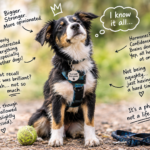
How to Help a Shy Puppy Gain Confidence
Can we talk about building confidence in our shy puppies for a second please?
Doing the job I do, I get to see the whole spectrum when it comes to puppy personalities.
A bit like us humans, some puppies are very outgoing and the life and soul of the party. Others prefer to take things a little more slowly and get used to the world around them at their own pace.
We need to work a little differently with both of those personality types.
For our very confident, exuberant puppies, we might need to teach them to calm down a little. Giving them breaks, helping them learn that spending time with Mum and Dad can be far more rewarding than racing over to say hello to that puppy over there. We want them to learn that they don’t have to interact with absolutely everything and everyone.
For those who are a little more reserved, we need to give them the opportunity to work things out for themselves.
One of things we don’t want to do with a puppy who is a little unsure is to put them into situations they can’t cope with (or not give them the chance to retreat if they feel overwhelmed) (Watching their body language gives us a huge amount of information about how they are feeling – if you would like to know more please just ask :0).
There’s an outdated idea that repeatedly exposing puppies (and dogs) to the things they’re worried about will help them get over their fears. But actually, it can be quite the opposite.
What we’re talking about is something called ‘flooding’. It’s the idea that if we expose them to something ‘frightening’ for long enough or often enough, they’ll eventually get used to it.
Spolier alert – That’s not how it works.
If a puppy is repeatedly exposed to something worrying without the opportunity to move a little further away or make their own choices, we can actually make that fear worse. Rather than learning that the world is a safe place, they can learn that the things they find worrying really are something to be concerned about.
And these can be the puppies who, as they get older, develop more significant fear-based behaviours and reactivity.
So how do we help our ‘wallflower’ puppies?
One of the best things we can do is let them observe, give them space and allow them to take things at their own pace.
Let’s say you have a puppy who’s a little unsure about meeting other puppies.
Don’t walk straight over to another puppy with yours. Remember, your puppy might follow you because they want to stay close to you, not because they actually want to meet that other puppy!
Instead, keep the lead as loose as possible (if it’s safe to do so take their lead off), give them some space and let them make the choices.
If they want to watch from a distance, that’s absolutely fine. If they decide they want to move a little closer, that’s fine too. And if they’d rather move away, listen to them.
You can use rewards to help build positive associations, but be careful not to use food as a bribe to encourage a puppy closer to something they’re actually worried about. We want them to choose to approach, not feel lured into a situation they’re uncomfortable with.
Good socialisation isn’t about how many things your puppy meets, how many dogs they play with or how many new experiences you can squeeze into a week.
It’s about the quality of those experiences.
A puppy who sits quietly watching the world from a comfortable distance is learning too. They don’t have to interact with everything to benefit from the experience.
So, if your puppy isn’t the life and soul of the party, please don’t worry about it.
They don’t need to be.
Our job is to help them develop confidence, not turn them into a completely different personality.
Take things slowly, give them choices, listen to what they’re telling you and, most importantly, don’t rush them.
Confidence comes from feeling safe, having choices and learning that you can cope with the world around you.
About the author:
Kate is a qualified dog trainer (KPA-CTP) specialising in puppy training and behaviour. She holds an MSc in Applied Animal Behaviour and Welfare and is a Certified Clinical Animal Behaviourist (CCAB), with over 10 years’ experience helping puppies, dogs and their owners.